Origin country
Croatia
Origin region
Bjelovar-Bilogora
Quantity available
100 Unit
Courier delivery
Yes
Free delivery up to (km)
10 km
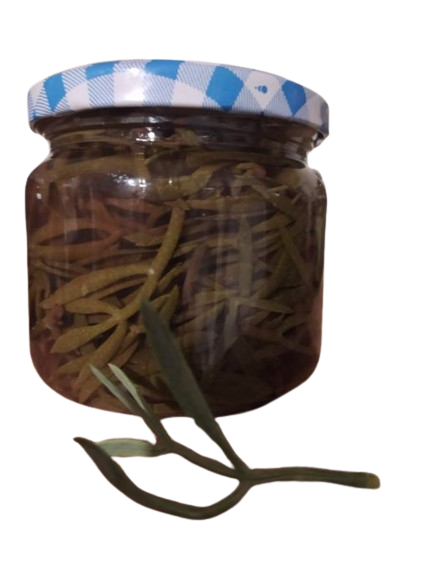
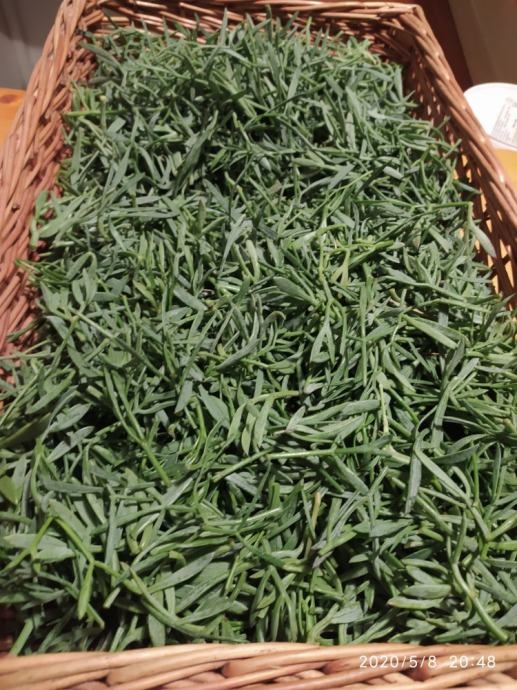
Many people lie near this wild plant in summer without knowing they are actually next to a great delicacy. This 'flower in stone,' known as samphire, matar, or petrovac, was considered the food of the gods, a prized plant in biblical times, and even mentioned by the famous Shakespeare. It is tasty and accessible, forgotten for a while, but now regarded as a great delicacy served on rich Dalmatian platters.
It is most delicious when harvested at the end of April, in May, or June, picked like asparagus—simply snapped off gently. It can also be harvested later, but then it is recommended to pick only the leaves. At this stage, its essential oil is more pronounced, giving it a different flavor.
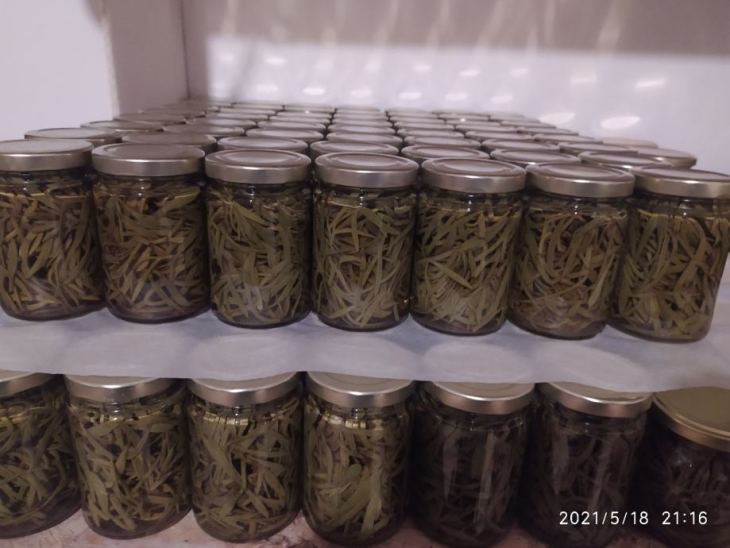
Otherwise, its taste is hard to describe. Samphire is salty and very aromatic, reminiscent of fennel, capers, and asparagus, yet distinct. In the kitchen, it is used like capers and asparagus—for salads, sauces, boiled dishes, and most commonly, pickled.
As a side dish, it pairs excellently with other Mediterranean delicacies, such as fish with grilled vegetables, salted anchovies, and sun-dried tomatoes. Its fleshy leaves can also be dried. Some of the essential oil evaporates during drying, allowing for dishes with a milder flavor.
Its leaves are rich in vitamin C, which is why many of our sailors used to take pickled samphire on voyages as a remedy against scurvy. Today, it is still used in medicine as an antiscorbutic and diuretic, for bladder and stomach issues, and is beneficial for detoxifying the body. It is also excellent for weight loss and rich in mineral salts.
Price:
212 ml = 4.00 €
Ukiseljeni Motar (Petrovac) - 212 ml
Mnogi ljeti leže pored ove samonikle biljke, ne znajući da se zapravo nalaze pored velike delicije. Ovaj cvijet u kamenu, motar, matar ili petrovac bio je hrana bogova, cijenjena biljka u biblijskim vremenima o kojoj je pisao i slavni Shakespeare. Ukusan je i dostupan, na neko vrijeme zaboravljen, a sada se smatra velikom delicijom koja se služi na bogatim dalmatinskim platama.
Najukusniji je kad ga se bere krajem travnja, u svibnju ili lipnju, a bere se kao šparoga- samo se lako otkine. Može se brati i kasnije, ali tada se preporuča berba samo listića. U toj se fazi više osjeća njegovo eterično ulje, pa je i okus drugačiji.
Inače, njegov okus teško je opisati. Može se reći da je motar slan i vrlo aromatičan, podsjeća na koromač, kapar i šparoge, a opet je različit. U kuhinji se primjenjuje kao kapar i šparoge, za salate, umake, na lešo, a najčešće se kiseli.
Kao prilog odlično se slaže s ostalim mediteranskim delicijama, kao što je riba s gradela, slani inčuni i sušene rajčice. I njegovi mesnati listovi se mogu sušiti. Tada dio eteričnog ulja ispari, pa se mogu raditi jela s blažim okusom.
Njegovi listovi bogati su vitaminom C pa je poznato kako su ih mnogi naši pomorci nosili ukiseljene na plovidbe kao sredstvo protiv skorbuta. I danas se koristi u medicini kao antiskorbutik i diuretik, kod tegoba s mjehurom i želucom, a koristan je i za detoksikaciju organizma. Izvrstan je i za mršavljenje te bogat mineralnim solima.
Cijena:
212 ml= 4,00 €
Brune Bušića 24
Pakoštane
23211
Croatia
Netfoodmarket is a specialized portal for producers and buyers in Croatia, Slovenia, Germany, Austria and European Union. Our clients can place and search offer and demand ads. After registering you can place one free ad, and if you create a company and pay membership, you will have PREMIUM benefits during one year. For the price of 60€, you will get your profile that you can edit so you can introduce yourself as best as you can because this portal is created for you. You can determine product prices and available quantities, see the statistics of clicks on your ads, use our practical delivery service by affordable prices, compare your prices with competition, place your recipes. Producers can browse demand ads, memebers can use our banner advertising at a special price ... Everything in one place! All Netfoodmarket members can use our customer service as their joined marketing team.
* Fields labeled with a star are mandatory
** At least one contact number is mandatory, phone or cell phone
* Password must contain at least 6 signs.