Origin country
Croatia
Origin region
Zagreb County
Quantity available
500 Unit
Courier delivery
Yes
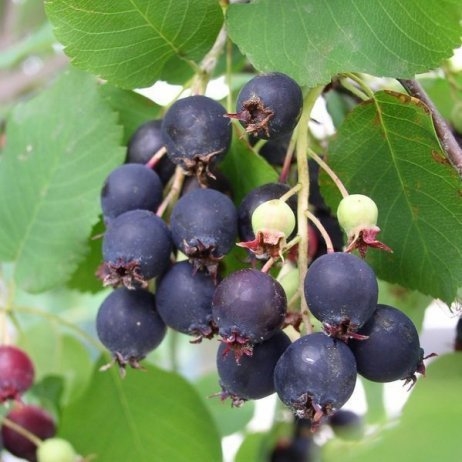
This plant originates from Canada, where it was created by crossing Mongolian and certain other species from South America. In Canada, it is also known as 'little apple.' The crossbreeding resulted in large fruit, with some varieties averaging up to 1.43 cm in diameter. The plant produces evenly ripened fruit. The ripe berries are dark blue, covered with a waxy coating, very tasty, with a mild flavor and juicy, offering an ideal balance of sugar and acidity. The lower and middle parts of the plant yield abundantly. The shrub grows to about 3 m, has a rounded shape, and is a highly variable species—it can form either a shrub or a small tree. Growth vigor varies, ranging from 30 cm to 6 m in height, though young shoots initially grow upward. During the growing season, the plant produces many shoots, typically forming a large, dense shrub. The bark is reddish-brown; young branches are wrinkled, while older ones are smooth. The leaves are usually oval, with coarsely serrated edges, about 7 cm long and 4 cm wide. The foliage develops during the flowering period from May 1st to 15th. The flowers are white, appearing in clusters of several dozen.
The fruit is round, typically dark blue or purple-black, with an average weight of 0.5–0.7 g and a diameter of 10–15 mm (up to 18 mm). It ripens from mid to late June, and the berries can remain on the shrub until winter. The fruit is very juicy, sweet, and flavorful. It is characterized by a high content of phenols, flavonoids, anthocyanins, minerals, and vitamins from groups A, B, C, and E, giving it anticancer and therapeutic properties. It has quickly found its place in herbal medicine. Mongolian blueberries are richer in minerals and have better nutritional properties than the well-known American blueberry. For example, 100 g of frozen Mongolian blueberries contains approximately 7 times more calcium and iron than the American variety, and 4 times more potassium and protein.
In potential production, they represent a great resource for making jams and juices. In processing, they are used as an additive (flavor enhancer) for other fruit products, especially those with a sour taste. However, their greatest advantage lies in fresh sales on the EU market, where strong interest was shown after presentations by Canadian growers. These growers are turning their export potential toward Japan, alongside the traditional market for Siberian blueberries.
Growing Requirements
In nature, the ancestors of Mongolian blueberries typically grow in open forests, on slopes, ravines, along streams, and river mouths, as well as in dry, sunny, rocky soils and very moist, fertile lowland soils. They do not thrive in areas with annual precipitation below 340 mm. At the same time, they are well-adapted to areas with frequent wildfires.
The plants tolerate a wide range of soil pH (optimal 6–7.5) and different soil structures, making them hardy and long-lasting, as mentioned above. On plantations, growth is expected even after 30 years. The plants begin bearing fruit immediately after planting. A larger yield is expected from years 3–4, and full productivity is reached at 6–8 years, with an expected yield of 8–10 t/hectare or 7.5 kg of berries per plant. The plants are self-pollinating, and the fruit ripens in clusters 45–60 days after flowering, i.e., in late June or early July, before currants and blueberries. Young shoots require rich, humus soil initially, but once the plants harden, they need little more than care. They thrive better in partial shade or full shade, which helps maintain soil moisture. The Mongolian blueberry is frost-resistant—shoots and flower buds can withstand temperatures down to -50°C during dormancy, though flowers may still be damaged by late spring frosts. The plants require a very short period of absolute dormancy, 400–600 hours at 0–7°C. No diseases or pests have been recorded on them.
The leaves and young shoots of the Mongolian blueberry are a tasty food, especially in winter, from December to March. Protection from wildlife and domestic animals such as sheep or goats is recommended. Although birds might eat the fruit, as expected with Siberian blueberries and goji berries, no serious attacks have occurred so far.
Plantation cultivation methods used by Canadian producers and recommended by experts: 1m x 4.5m, 1m x 4.75m, 1m x 6.2m, 1.25m x 4.5m, or 1.25m x 4.75m, i.e., 2,200–1,760 plants per hectare.
Mongolska Borovnica 1 godišnja sadnica
Biljka dolazi iz Kanade, nastala je križanjem mongolskih i nekih drugih vrsta iz Južne Amerike, a u Kanadi je još nazivaju i ''little apple“ tj. „mala jabuka“. Križanjem se dobio veliki plod, koji kod nekih sorti može biti prosječno i do 1,43 cm promjera. Biljka daje ravnomjerno zrele plodove. Zreli plodovi su tamnoplave boje, prekriveni voštanim premazom, vrlo su ukusni, blagog okusa te sočni, idealnog omjera šećera i kiselina. U donjem i srednjem dijelu biljka rodi u izobilju. Grm biljke raste cca. do 3 m, a ima zaobljeni oblik i vrlo je varijabilna vrsta, pa može stvoriti grm ili drvce. Snaga rasta kod biljaka varira, može ići od 30 cm do 6 m visine, no mladice u početku rastu u vis. Biljka u vegetaciji daje puno mladica, obično tvori veliki gusti grm. Kora je crvenkasto-smeđe boje, kod mladih grana je naborana, dok su starije grane glatke. Listovi su obično ovalni, s grubo nazubljenim rubovima, dužine 7cm i širine 4 cm. Lisna masa se razvija tijekom cvatnje u periodi od 01.-15. svibnja. Cvjetići su bijeli, ima ih nekoliko desetaka u grozdovima.
Plodovi su okrugli, obično tamnoplavi ili ljubičasto-crni, prosječne težine 0,5-0,7 g, promjera 10-15 mm (18 mm). Dozrijeva od sredine do kraja lipnja, a plodovi mogu ostati na grmu do zime. Plodovi su vrlo sočni, slatki i ukusni. Karakterizira ih visok sadržaj fenola, flavanoida, anticijanina, minerala i vitaminima iz skupine A, B, C i E, stoga imaju antikancerogena terapijska svojstva. Već nakon kratkog vremena uzgoja našla je svoje mjesto u biljnoj medicini. Mongolske borovnice su bogatije mineralima i imaju bolja nutritivna svojstva nego daleko poznata američka borovnica. Na primjer, 100 g smrznutih mongolskih borovnica ima približno 7 puta više kalcija i željeza od američke borovnice, a čak 4 puta više kalija i proteina.
U potencijalnoj proizvodnji predstavljaju veliki resurs za proizvodnju džemova i sokova. U preradi, koriste se kao dodatak (poboljšivač okusa) drugim voćnim proizvodima, posebno onim s kiselim okusom. No, ipak je najveća prednost u plasmanu u svježem stanju na EU tržište, gdje je na burzama pokazan veliki interes nakon prezentacije kanadskih uzgajivača, koji svoj potencijal plasmana okreću prema Japanu, uz tradicionalan plasman Sibirskih borovnica.
Zahtjevi za uzgoj
U prirodi, preci Mongolskih borovnica obično rastu u otvorenim šumama, na obroncima, gudurama, uz potoke i ušćima rijeka, ali i suhim i kamenitim tlima punim sunca, te vrlo vlažnim i plodnim tlima u nizinskom području. Ne obitava na područjima gdje je godišnja količina oborina manja od 340 mm. U isto vrijeme, vrlo dobro je prilagođena za područja u kojima ima često požara.
Biljke toleriraju širok raspon pH tla (optimalno 6-7,5 pH), te različite strukture tla, stoga je izdržljiva i trajna, kao što je gore već navedeno. Na plantažama se očekuje rast i nakon 30 godina. Biljke ulaze u rod odmah nakon sadnje. Veći rod očekuje se od 3-4 godine, a u punu rodnost ulaze od 6-8 godine i tada se očekuje prinos od 8-10 t/hektru ili 7,5 kg bobica/biljci. Biljke su samooplodne, plodovi dozrijevaju u grozdovima 45-60 dana od cvatnje, odnosno krajem lipnja, početkom srpnja, prije ribizla i borovnica. Mladice su zahtjevnije i one bi trebale biti sađene u visoko bogato humusno tlo, a nakon toga, kad biljke očvrsnu, ne traže ništa više osim Vaše ljubavi . Bolje uspijevaju u djelomičnom hladu ili punoj sjeni, što omogućuje veću vlažnost tla. Mongolska borovnica otporna je na mraz - izbojci i cvjetni pupovi tijekom mirovanja mogu izdržati do - 50° C, ali cvjetovi ipak mogu biti oštećeni kasnim proljetnim mrazom. Biljke traže vrlo kratko razdoblje apsolutnog odmora, 400-600 sati i to samo na 0-7°C.Na njima nije zabilježen nikakav napad bolesti ili štetnika.
Listovi i mladi izboji Mongolske borovice su ukusna hrana, osobito u zimskim mjesecima, od prosinca do ožujka. Preporuka je u uzgoju zaštita od divljači, ali i domaćih životinja, poput ovaca ili koza. Iako se očekuje da bi plodove mogle jesti ptice, kao što se i očekivalo kod Sibirske borovnice i Goji bobica, do ozbiljnijih napada do sada nije došlo.
Plantažni uzgoj koji koriste kanadski proizvođači i sugerira struka: 1m x4,5 m, 1m x4,75 m, 1m x 6,2m, 1,25 x4,5 m ili 1,25 m x 4,75 m, dakle od 2200 -1760 kom/ha.

Krapinska 12
Bistra
10298
Croatia
Netfoodmarket is a specialized portal for producers and buyers in Croatia, Slovenia, Germany, Austria and European Union. Our clients can place and search offer and demand ads. After registering you can place one free ad, and if you create a company and pay membership, you will have PREMIUM benefits during one year. For the price of 60€, you will get your profile that you can edit so you can introduce yourself as best as you can because this portal is created for you. You can determine product prices and available quantities, see the statistics of clicks on your ads, use our practical delivery service by affordable prices, compare your prices with competition, place your recipes. Producers can browse demand ads, memebers can use our banner advertising at a special price ... Everything in one place! All Netfoodmarket members can use our customer service as their joined marketing team.
* Fields labeled with a star are mandatory
** At least one contact number is mandatory, phone or cell phone
* Password must contain at least 6 signs.