Origin country
Croatia
Origin region
Zagreb County
Quantity available
500 Unit
Courier delivery
Yes
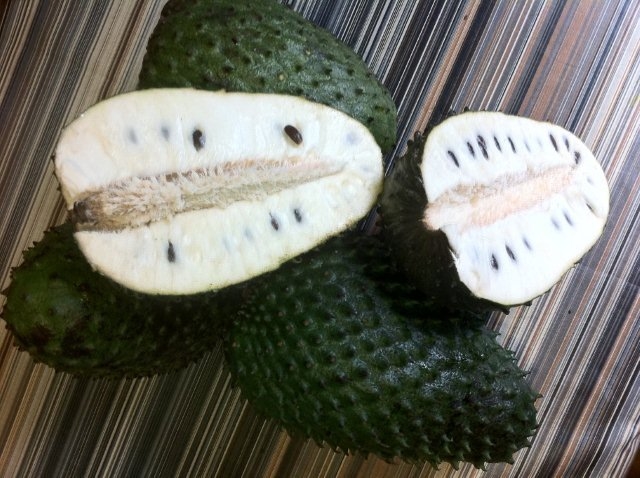
Soursop is the fruit of the evergreen tree Annona muricata, native to Mexico, Cuba, Central America, the Caribbean, and northern South America: Colombia, Brazil, Peru, Thailand, Malaysia, and Indonesia. Soursop is also produced in Africa and on some Pacific islands. It belongs to the same family as cherimoya and the Indian banana or pawpaw.
Soursop is adapted to areas of high humidity and relatively warm winters; temperatures below 5 °C (41 °F) will cause damage to leaves and small branches, and temperatures below 3 °C (37 °F) can be fatal. The fruit becomes dry and is no longer able to ripen.
The taste is described as a combination of strawberry and pineapple with citrusy sour notes, contrasting with the underlying creamy flavor reminiscent of coconut or banana. Certainly a perfect taste.
Cultivation and Use
The plant is grown commercially for its 20–30 cm long, spiky, green fruit, which can weigh up to 6 kg.
Far from its native region, limited production occurs as far north as southern Florida—Zone 10; however, it is mostly grown for personal use. It is also cultivated in parts of Southeast Asia and abundantly on the island of Mauritius. Soursop fruit can be grown in pots, even in temperate climates, if protected from the cold.
The fruit consists of an edible part—white, fibrous flesh—and a core of indigestible black seeds. It is the only member of its family suitable for processing and preservation. The sweet pulp is used for juice, sorbet, ice cream, frappés, and shakes.
Health
Nutritionally, the fruit is rich in carbohydrates, particularly fructose, and contains significant amounts of vitamin C, vitamin B1, and vitamin B2.
Graviola
Graviola je plod Annona muricate zimzelenog drveta porijeklom iz Meksika, Kube, Srednje Americe, Kariba i sjeverne Južne Amerike: Kolumbija, Brazil, Peru, Tajland, Malezija i Indonezija. Graviola je također proizveden u Africi, kao i na nekim Pacifiičkim otocima. Spada u istu porodicu kao chirimoya i indijanska banana ili pawpaw.
Soursop je prilagođen područjima visoke vlažnosti i relativno toplim zimama; temperaturama ispod 5 ° C (41 ° C) će uzrokovati oštećenja lišća i malih ogranaka, i temperaturama ispod 3 ° C (37 ° C) može biti kobno. Plod postaje suha i više nije u stanju dozrjeti.
Okus je opisan kao kombinacija jagoda i ananasa s kiselim notama citrusa, okus kontrastne s temeljnim kremastim okusom podsjeća na kokos ili bananu. Svakako savršenog okusa
Uzgoj i uporaba
Biljka se uzgaja kao komercijalni plodovi od 20-30 cm , bodljikavi, zeleno voća, mogu imati težinu do 6 kg.
Daleko od svog rodnog područja, je ograničena proizvodnja javlja na sjeveru kao južnoj Floridi -zone 10, međutim, to su uglavnom uzgaja za vlastite potrebe. Također se uzgaja u dijelovima jugoistočne Azije i obilnom na otoku Mauricijusu. Soursop voće može se uzgajati u teglama, čak iu umjerenim klimama, ako je zaštićena od hladnoće.
Voća se sastoji od jestivog dijela , bijelog mesa, vlaknasta, i jezgre neprobavljivih crnih sjemenki. Jedini član iz porodice pogodan za obradu i čuvanje. Slatka pulpa se koristi kao sok, , sorbet za sladoled , frape i shake-ve.
Zdravlje
Nutricionistički, plod ima puno ugljikohidrata, posebno fruktoze, sadrži značajne količine vitamina C, vitamina B1, i vitamina B2.

Krapinska 12
Bistra
10298
Croatia
Netfoodmarket is a specialized portal for producers and buyers in Croatia, Slovenia, Germany, Austria and European Union. Our clients can place and search offer and demand ads. After registering you can place one free ad, and if you create a company and pay membership, you will have PREMIUM benefits during one year. For the price of 60€, you will get your profile that you can edit so you can introduce yourself as best as you can because this portal is created for you. You can determine product prices and available quantities, see the statistics of clicks on your ads, use our practical delivery service by affordable prices, compare your prices with competition, place your recipes. Producers can browse demand ads, memebers can use our banner advertising at a special price ... Everything in one place! All Netfoodmarket members can use our customer service as their joined marketing team.
* Fields labeled with a star are mandatory
** At least one contact number is mandatory, phone or cell phone
* Password must contain at least 6 signs.